The Six-Week Sentence
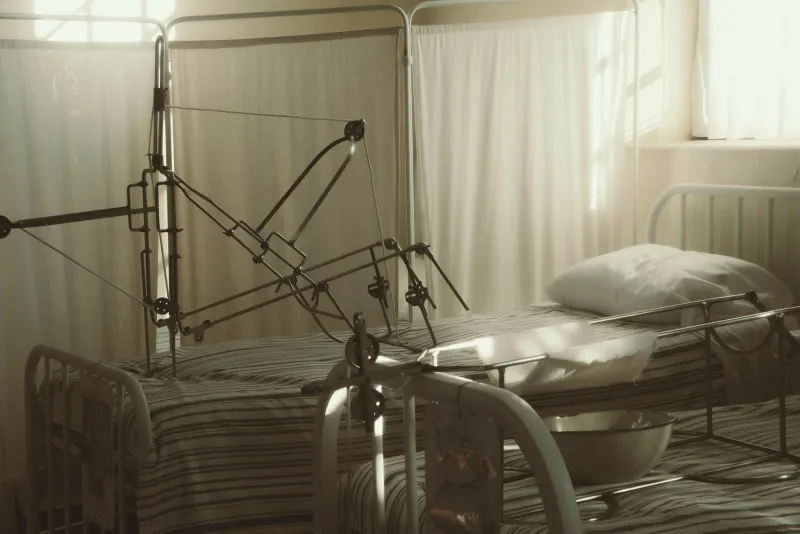
In 1955, breaking your leg wasn't just painful—it was life-altering. The moment you heard that crack, you knew your next six to eight weeks were already planned out. Heavy plaster cast from hip to toe. Crutches that left your armpits raw. Weeks of bed rest that doctors insisted was "essential for proper healing."
Mary Patterson of Toledo, Ohio, broke her ankle in 1958 stepping off a curb downtown. The treatment was standard: a thick white cast that weighed nearly four pounds, mandatory elevation of the leg for two weeks, and strict orders not to put any weight on it for six weeks minimum. She missed her daughter's school play, couldn't drive for two months, and needed help with basic tasks like bathing and cooking.
 Photo: Toledo, Ohio, via businessviewmagazine.com
"The cast was like wearing a concrete boot," she remembered years later. "And the itching—you'd go crazy trying not to stick something down there to scratch."
This was orthopedic medicine in mid-century America: functional, but crude. Doctors set bones by feel, held them in place with plaster, and hoped for the best. X-rays were basic, surgical options limited, and recovery was measured in months, not days.
The Technology Revolution Nobody Noticed
While Americans were watching the space race and computer revolution unfold on television, a quieter transformation was happening in operating rooms across the country. Orthopedic surgery was becoming something entirely different.
Today, that same ankle break Mary Patterson endured would likely be treated with minimally invasive surgery, titanium screws placed with millimeter precision, and a walking boot that comes off in three weeks. Some patients go home the same day.
The change started in the 1970s with arthroscopic surgery—tiny cameras that let surgeons see inside joints without major incisions. By the 1990s, computer-assisted surgery was helping doctors plan procedures with unprecedented accuracy. Now, robotic systems like the MAKO robot guide surgeons through joint replacements with precision that would have seemed like science fiction to doctors in the 1950s.
"We can now repair a complex fracture through an incision smaller than what used to be needed just to look at the problem," explains Dr. Sarah Chen, an orthopedic surgeon at Cleveland Clinic. "What used to require opening someone up completely now happens through keyhole surgery."
 Photo: Cleveland Clinic, via seeklogo.com
Materials That Heal Themselves
The plaster cast itself—that symbol of broken bone misery—is becoming obsolete. Modern fracture care uses materials that would have amazed doctors just two decades ago.
Bioresorbable implants dissolve harmlessly in the body as bones heal, eliminating the need for follow-up surgeries to remove hardware. 3D-printed casts, custom-fit to each patient's anatomy, weigh a fraction of traditional plaster and allow patients to shower normally. Some newer casts even monitor healing progress through embedded sensors.
Bone grafts, once requiring painful harvesting from the patient's hip, can now be grown in laboratories or replaced with synthetic materials that encourage natural bone growth. The six-week plaster prison has been replaced by treatments that work with the body's natural healing process instead of simply immobilizing it.
The Recovery Revolution
Perhaps the biggest change is in how we think about recovery itself. The bed rest that doctors once prescribed as essential is now known to slow healing and cause additional problems. Modern orthopedic care emphasizes movement, not immobilization.
Physical therapy begins within hours of surgery. Patients are encouraged to bear weight as soon as possible. Recovery programs focus on returning people to their normal activities, not just healing the break.
John Martinez broke his leg in a skiing accident in Colorado last winter. Three days later, he was back at his desk job in Denver, wearing a lightweight walking boot and attending physical therapy twice a week. The total time away from normal activities: less than two weeks.
"My grandfather broke his leg in the 1960s and was basically an invalid for three months," Martinez says. "I was worried I'd miss my son's baseball season. Instead, I was coaching his games six weeks later."
The Hidden Cost of Progress
This medical revolution hasn't come cheap. While a broken bone in 1955 might have cost the equivalent of $500 in today's money, modern orthopedic procedures can run into tens of thousands of dollars. The technology that makes same-day recovery possible requires enormous investments in equipment, training, and facilities.
Robotic surgical systems cost hospitals millions of dollars. The specialized materials and implants that speed healing come with premium price tags. Insurance coverage varies widely, and some patients find themselves choosing between the latest treatments and financial stability.
Looking Back, Moving Forward
The transformation of orthopedic care represents one of medicine's quiet success stories. While we celebrate dramatic advances like organ transplants and cancer treatments, the revolution in broken bone care has improved millions of lives without much fanfare.
Mary Patterson, now 89, recently had a hip replacement using robotic-assisted surgery. She was walking the next day and home within 48 hours—a procedure that would have required weeks in the hospital and months of recovery just a generation ago.
"It's like a miracle compared to what we went through back then," she says. "Young people today have no idea how lucky they are."
The plaster cast may have symbolized healing for generations of Americans, but its disappearance represents something better: medicine that restores lives instead of just repairing bones. From hardware store to high-tech operating room, the journey of orthopedic care shows how far we've come—and how much we've forgotten about the way things used to be.