The Clock Hit 5 and He Was Gone. You Hit 5 and Your Phone Starts Buzzing.
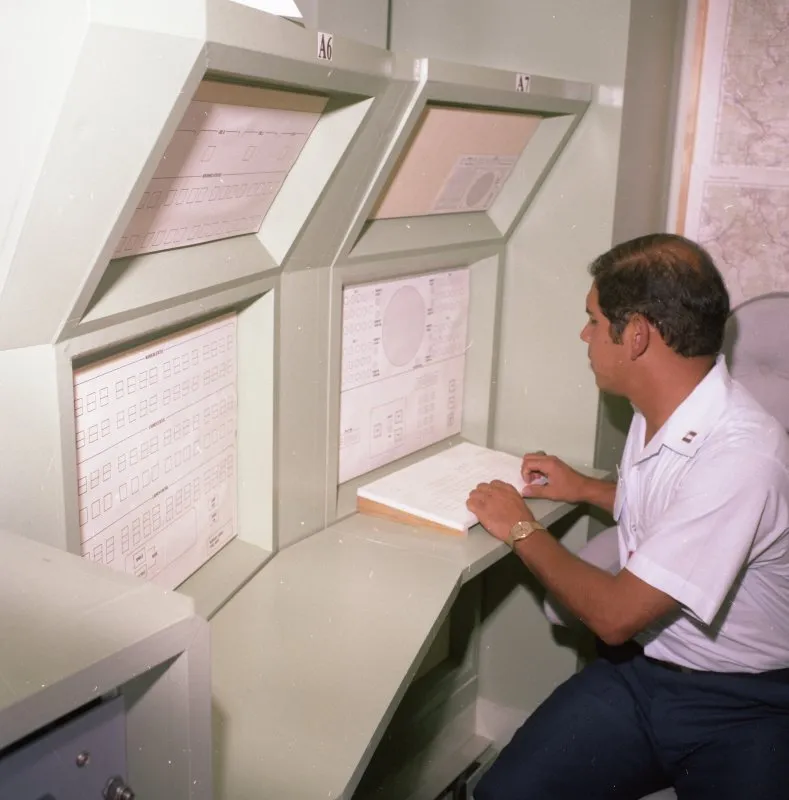
Photo: San Diego Air & Space Museum Archives, Public domain, via Wikimedia Commons
Picture your grandfather leaving the plant or the office in 1972. He walks out the door at five o'clock, gets in the car, drives home, and that's it. The job stays at the job. There's no mechanism by which his supervisor can reach him at the dinner table. There's no way for a client in another time zone to drop a question into his lap at 9 PM. He is, by every practical definition, off work.
He probably didn't think of this as a luxury. It was just how things worked.
Now think about the last time you were truly, completely unreachable during working hours — not on vacation with a deliberate out-of-office, but just a regular Tuesday evening where no work thought entered your head and no work message demanded your attention. For most American workers today, that kind of evening is either rare, carefully constructed, or simply gone.
What a Boundary Used to Look Like
For most of the twentieth century, the end of the workday was enforced by infrastructure as much as by culture. If you worked in an office, the office had a phone — a physical object attached to a wall in a building you were no longer in. If you worked in a factory, the machinery was in the factory. The work lived somewhere specific, and when you left that place, you left the work.
This wasn't universal. Farmers, doctors, small business owners — plenty of Americans have always carried work home with them in one form or another. But for the broad middle of the workforce, the physical separation between workplace and home created a psychological separation that required no willpower to maintain. You didn't have to resist checking your work email because there was no mechanism for checking your work email. The boundary was structural.
The 40-hour workweek, formalized through the Fair Labor Standards Act in 1938, was built on this assumption. Work happened in defined hours in a defined location. Outside those hours, you were a citizen, a parent, a neighbor — not an employee on standby.
The Slow Dissolve
The first cracks appeared with the pager, which let employers reach workers outside the office for urgent matters. Then came the BlackBerry — the device that, in retrospect, changed everything. Suddenly, email was in your pocket. Suddenly, urgent was redefined.
The smartphone finished the job. By the early 2010s, the tools that let you do your work from anywhere had become the tools that meant your work expected you anywhere. Slack, Microsoft Teams, and similar platforms arrived next, creating a persistent ambient layer of workplace communication that doesn't respect evenings, weekends, or the fact that you're in the middle of dinner with your kids.
The language shifted too. "Availability" became a professional virtue. Being responsive — quickly, at any hour — became a signal of dedication. Workers who didn't answer messages promptly risked being seen as disengaged, regardless of whether the message arrived at 6 PM on a Friday.
Nobody made a deliberate decision that this was how things should work. It just accumulated, tool by tool, expectation by expectation, until the boundary was gone and almost nobody could remember exactly when it disappeared.
The Numbers Behind the Blur
The data on this is striking. A 2021 survey by the American Psychological Association found that more than half of employed Americans reported checking work messages outside of work hours, with a significant portion doing so during family time, evenings, and weekends. Separate research from Harvard Business School found that the average professional workday had extended by roughly 48 minutes during the shift to remote work — not because people were assigned more hours, but because the ambient availability of work tools made it harder to stop.
The irony is that remote work, which was sold in part as a benefit that would give workers more flexibility and autonomy, also made the dissolution of work-life separation almost complete. When your office is your kitchen table, the question of when you're "at work" becomes genuinely difficult to answer.
What We Lost When the Boundary Dissolved
The case for always-on work culture usually goes something like this: flexibility is a two-way street. If your employer can reach you at 7 PM, you can also run an errand at 2 PM. You're trading rigid hours for fluid ones. That's a reasonable argument, and for some workers in some roles, it's genuinely true.
But the psychological research on rest tells a more complicated story. Real cognitive recovery — the kind that makes you better at your job the next day — requires mental disengagement from work, not just physical absence from the office. Checking your phone for messages while watching TV doesn't count as rest. Neither does lying in bed mentally drafting a reply to an email that arrived after dinner.
The constant low-level awareness that work could demand your attention, even when it currently isn't, is itself a form of cognitive load. Researchers call it "psychological detachment," and studies consistently show that workers who can't achieve it report higher rates of burnout, worse sleep, more relationship strain, and lower long-term job performance. We didn't just lose the evening. We lost the recovery that the evening was supposed to provide.
Back Then, the Off Switch Was Built In
Your grandfather didn't need discipline to leave work at work. The system did it for him. Today, maintaining that boundary requires active, ongoing effort against a current that runs in the other direction — company culture, peer behavior, the quiet professional anxiety that being unreachable means being forgettable.
That's a meaningful difference. We've made work more portable, more flexible, and in some ways more humane. But we've also made it inescapable in a way that no previous generation of American workers had to navigate.
The clock still hits five. It just doesn't mean what it used to.