Before the First Cry, You Already Knew Her Face
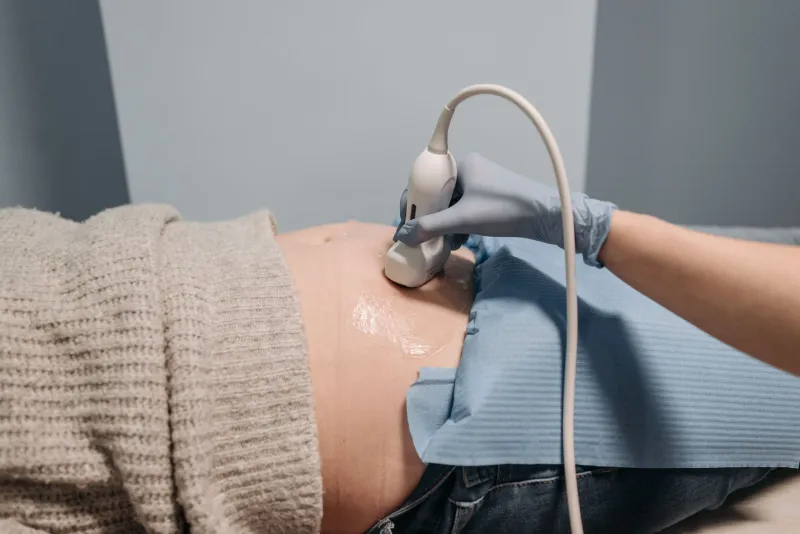
There's a photograph tucked inside millions of baby albums across America. It's grainy, black and white, and looks something like a weather radar image caught mid-storm. A curved spine. A suggestion of fingers. Maybe a profile, if you tilt your head just right. That image — a first ultrasound — feels almost quaint now, like a polaroid in a world of 8K video.
But go back fifty years, and there was no image at all.
The Invisible Pregnancy
For most of human history, pregnancy was a private mystery. You knew something was growing inside you. You felt it kick. You watched your body change. But the child itself — their face, their features, whether they were a boy or a girl — remained completely hidden until the moment they arrived.
In the early 1970s, obstetric ultrasound was just beginning to enter American hospitals, and even then, it was used sparingly — reserved for detecting complications, not routine check-ins. Most expectant mothers in that era went to their OB appointments, listened to a heartbeat through a stethoscope, and went home to wait. There were no images to frame. No profile shots to text to grandparents. The baby was, in the most literal sense, a surprise.
That anticipation wasn't just tolerated — it was expected. You painted the nursery yellow because you didn't know whether it would be a boy or a girl. You had two names ready. The not-knowing was simply part of the experience.
The Scan That Changed Everything
By the 1980s, routine ultrasound had become standard practice in American obstetric care. The technology improved steadily — resolution sharpened, equipment became more accessible, and the 20-week anatomy scan became a landmark appointment rather than a clinical exception. Suddenly, parents weren't just hearing a heartbeat. They were watching a baby yawn.
Then came 3D imaging in the 1990s, followed by 4D ultrasound — real-time video of a fetus in the womb — and the experience of pregnancy transformed completely. Today, private ultrasound studios have popped up in strip malls across the country, offering keepsake sessions where parents watch their unborn child stretch, blink, and suck their thumb on a flat-screen television. You can walk out with a USB drive full of footage.
The gender reveal, once a brief conversation with your doctor, became a cultural event. Colored powder cannons. Cake with pink or blue filling. Balloon releases photographed for Instagram. An entire economy has grown around the moment that used to happen in a delivery room, witnessed by two exhausted people and a nurse.
What We Gained
To be fair, the medical case for prenatal imaging is ironclad. Early detection of structural abnormalities, placental complications, and growth issues has genuinely saved lives and given families critical time to prepare. Parents who receive difficult diagnoses in utero can connect with specialists, research conditions, and make informed decisions about delivery and care. The visibility isn't just emotional — it's clinical, and it matters.
For high-risk pregnancies especially, regular monitoring has shifted outcomes in meaningful ways. Conditions that once went undetected until delivery — or until something went wrong — are now identified and managed months in advance. That's not a small thing. That's medicine doing exactly what it's supposed to do.
What We Might Have Given Up
But something else shifted alongside the technology, and it's harder to measure.
When you've watched your daughter's face on a screen a dozen times before she's born — when you've already named her, photographed her, announced her on social media — the experience of meeting her for the first time changes. Not necessarily for the worse. But differently.
Some researchers and child psychologists have raised quiet questions about what constant prenatal documentation does to the imagination. There was something in the old model — the not-knowing — that forced parents to hold an open, undefined idea of their child. You couldn't project too specifically. You couldn't pre-build an image. The baby arrived and you discovered them.
Today, parents sometimes describe a strange sense of recognition at birth — oh, there you are — because the face was already familiar. That's beautiful in its own way. But it's a fundamentally different experience from the one that shaped every generation before roughly 1985.
There's also the question of anxiety. More information doesn't always mean more peace of mind. Every scan carries the potential for an unexpected finding. Every measurement gets Googled. Every percentile gets worried over. The visibility that was meant to reassure can, for some parents, create a new category of fear that simply didn't exist when there was nothing to see.
The Shoebox vs. The Cloud
A mother in 1973 might have had a handful of memories from her pregnancy: the first kick, the growing belly, the name she finally settled on. Today, an expectant parent might have hundreds of images, several video clips, a curated Instagram highlight, and a framed ultrasound print hanging in the nursery — all before the child has taken a breath.
Neither version is wrong. But they are radically different ways of entering parenthood, shaped by technology that moved faster than our ability to fully understand what it was changing.
We gained knowledge, certainty, and preparation. We gained the ability to detect problems early and respond to them. We also quietly gave up the particular kind of wonder that only lives inside the unknown — the version of your child that existed purely in your imagination, unconstrained by a grainy image or a gender reveal balloon.
Some things, once seen, can't be unseen. That's the deal with progress. You take the gift and you figure out later what came with it.