The Kitchen Vanished: How America Stopped Cooking for Itself
When Cooking Was Non-Negotiable
In 1974, the average American family ate dinner together at home five to six nights a week. Eating out was an event—a special occasion marked on the calendar, something you dressed up for, something that cost real money. For most households, the question wasn't whether to cook dinner; it was what to cook.
This wasn't a lifestyle choice. It was simply how life worked. Mothers—and it was almost always mothers—spent hours each week planning meals, shopping for ingredients, and preparing food. Casseroles, roasted vegetables, meat and potatoes, homemade desserts. The kitchen was the center of the household, not in a Pinterest-aesthetic way, but in a purely functional way. If you wanted to eat, someone had to cook.
The economics were brutal in their simplicity. Buying ingredients and cooking them at home was cheap. Buying prepared food was expensive and rare. A family of four might spend what felt like a fortune on a single dinner at a restaurant. For most Americans, this wasn't an option worth considering.
Children grew up watching their parents cook. They learned which vegetables needed to be peeled, how long chicken took to roast, why you didn't skip the salt. Cooking knowledge moved through families like a language, passed down without fanfare.
The Machinery of Change
Then, almost imperceptibly at first, everything shifted.
The first domino was women entering the workforce in large numbers. Through the 1970s and 1980s, the percentage of mothers with jobs outside the home climbed steadily. By 1990, a majority of married women with children worked for pay. This created an immediate, practical problem: someone still needed to cook dinner, but the person who had always done it now had eight hours of other work to do first.
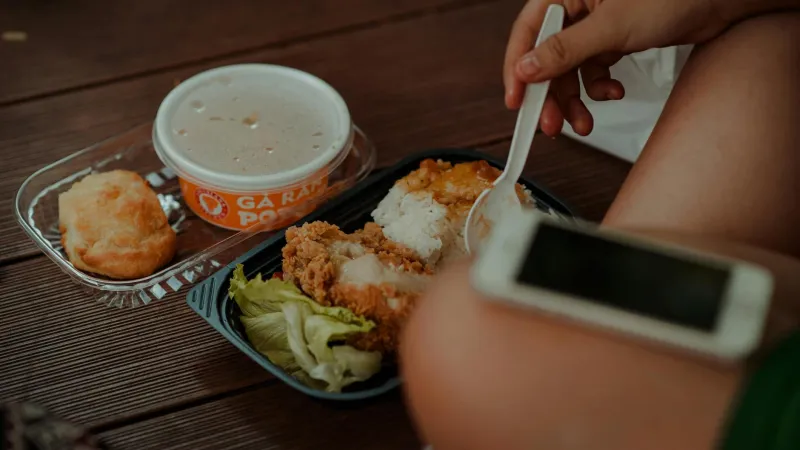
The fast food industry was waiting. McDonald's, which had been a novelty in the 1950s, became ubiquitous by the 1970s. Wendy's, Burger King, Taco Bell, Chick-fil-A—chains multiplied and spread. The pitch was simple and powerful: We'll feed your family tonight so you don't have to cook. The price was low enough to be accessible to working families. The food was consistent. You didn't have to think about it.
But fast food was just the opening move. The real transformation came from the grocery store itself. Frozen dinners became sophisticated. Rotisserie chickens appeared in supermarkets. Takeout containers replaced pots and pans. Restaurants, once rare luxuries, became as common as gas stations. By the early 2000s, Americans were spending more than 40 percent of their food budget on meals eaten outside the home.
The infrastructure of home cooking began to disappear. Grocery stores reduced their fresh produce sections. Cooking-focused cooking shows gave way to restaurants and celebrity chefs. Kitchens, which had been designed as workspaces, became showpieces. Young people didn't learn to cook because there was no one home to teach them, and no reason to learn—why spend two hours making pasta when you could have it delivered in thirty minutes?
The Hidden Math
Here's what's strange: it wasn't actually cheaper.
A home-cooked meal costs roughly $2 to $4 per person. A fast food meal costs $7 to $12. A restaurant meal costs $15 to $25 or more. If you're eating out most nights, you're spending two to three times as much as you would if you cooked at home. Yet millions of American families do exactly this, spending money they don't have on food they don't actually want, simply because the alternative—cooking—requires time and knowledge they've lost.
The math reveals something uncomfortable: the shift away from home cooking wasn't really about money. It was about the value placed on time. When mothers entered the workforce, someone had to lose something. It turned out that what got lost was the evening meal together, made from scratch, at home.
But there was a trade-off nobody quite calculated: the cost of convenience.
When you buy prepared food, you're not just paying for ingredients. You're paying for packaging, transportation, marketing, profit margins. You're also outsourcing the knowledge. The person cooking your meal is making $15 an hour and has no incentive to use quality ingredients or careful technique. You get fed, but the meal is designed for efficiency, not nutrition or satisfaction.
Home cooking, by contrast, is inefficient in the best possible way. It teaches you things. It requires you to think about what you're eating. It allows for improvisation and preference. It's slower, which is often the point.
What We Lost (And What We Gained)
The consequences of the cooking exodus have been subtle but profound.
Nutrition suffered. Home-cooked meals, on average, contain fewer calories, less sodium, less sugar, and more vegetables than restaurant or fast food meals. The obesity epidemic that began in the 1980s and accelerated through the 1990s and 2000s correlates directly with the decline of home cooking. Children born in 1990 were far more likely to grow up overweight than children born in 1970, and the change in what and where they ate is a major factor.
Family structure changed too. The shared meal—that nightly gathering around the table—had been one of the few guaranteed moments of connection. When dinner moved to the car or the couch or didn't happen together at all, something about family life fractured. Research consistently shows that families who eat together have better communication, stronger relationships, and children with better academic outcomes. But this requires someone to cook, and by the 1990s, fewer people were willing or able to do it.
Knowledge disappeared. Entire generations grew up without learning how to cook. Young adults today are more likely to feel confident ordering from DoorDash than making a simple pasta sauce. The skills that were once considered basic life competency became specialized knowledge, something you had to deliberately learn rather than something you absorbed.
But there's a counternarrative too. For many people—particularly women—the decline of the requirement to cook was liberation. A woman in 1950 had few choices. She cooked because that was her role. The ability to buy prepared food meant she could work, pursue education, have a life beyond the kitchen. That's not nothing.
The Quiet Reversal
In the last decade, something unexpected has happened. Cooking has become trendy again, but it's been rebranded. It's no longer a chore; it's self-care. It's not a requirement; it's a lifestyle choice. Sourdough starters became pandemic status symbols. Cooking shows returned to television, now positioned as entertainment rather than instruction. Young people, many of whom grew up eating fast food, are discovering that they actually want to know how to cook.
This new cooking movement is real but also deeply unequal. It's available to people with time and disposable income—people who can afford to spend $15 on artisanal ingredients for a meal that takes two hours to prepare. For working families living paycheck to paycheck, the convenience economy remains the only realistic option.
What the fifty-year arc of American cooking reveals is that how we feed ourselves isn't really about food. It's about time, money, knowledge, and who bears the responsibility for keeping everyone nourished. We solved the time problem by outsourcing cooking. But we didn't really solve it—we just shifted the burden, and the cost, in ways we're still trying to understand.