When Your Corner Drugstore Had a Soda Fountain and the Pharmacist Knew Your Dog's Name
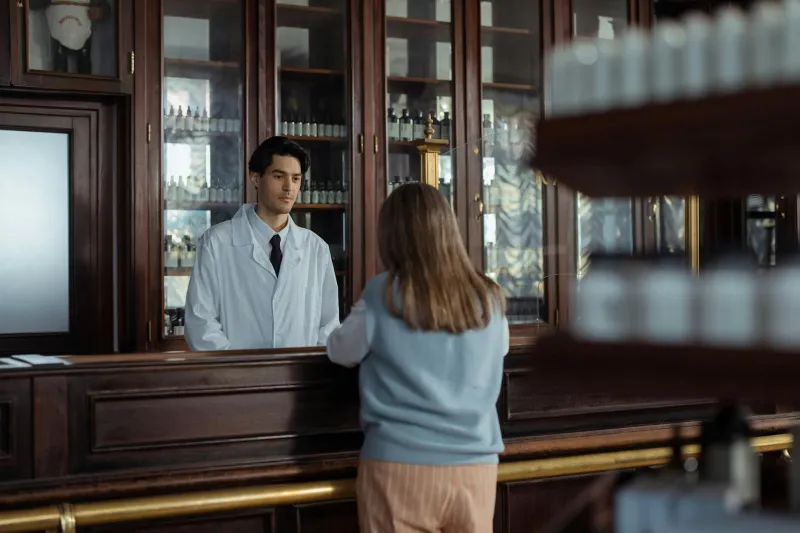
The Neighborhood Gathering Place
Walk into a CVS or Walgreens today, and you're hit with fluorescent lighting, endless aisles of products, and a pharmacy counter that feels more like a DMV window than a place of healing. But rewind to 1955, and stepping into Murphy's Drug Store on Main Street was an entirely different experience.
The bell above the door would chime as you entered, and Mr. Murphy himself would look up from behind the prescription counter with a genuine smile. "How's your mother's blood pressure doing?" he'd ask, because he actually remembered filling her medication last month. The air smelled like cherry syrup and fresh coffee, not the antiseptic scent that defines modern pharmacies.
To your left sat the soda fountain—a gleaming chrome and marble masterpiece where teenagers gathered after school and businessmen grabbed quick lunches. The pharmacist wasn't just a pill-dispenser hiding behind plexiglass; he was a trusted healthcare advisor, a small business owner, and often the unofficial mayor of the neighborhood.
More Than Medicine
The mid-century drugstore was a curious hybrid that today's corporate efficiency experts would find baffling. Why would you sell ice cream sundaes next to prescription medications? Why would a pharmacy need a lunch counter that served grilled cheese sandwiches and tomato soup?
Because the neighborhood drugstore wasn't just about healthcare—it was about community. The soda fountain drew people in, creating a natural gathering space where neighbors bumped into each other, kids spent their allowance money, and the pharmacist could keep an eye on the health and wellbeing of his customers in ways that went far beyond their prescription bottles.
These weren't massive operations. Most employed just a handful of people: the pharmacist-owner, maybe his wife helping with the books, a soda jerk who knew whether you liked extra whipped cream, and perhaps a part-time clerk. Everyone knew everyone, and that personal connection extended to healthcare in ways we've almost entirely lost.
When Pharmacists Were Family Friends
Back then, your pharmacist was likely a pillar of the community who'd attended the local college of pharmacy, returned to his hometown, and planned to stay put for the next forty years. He knew your family's medical history not because it was in a computer system, but because he'd been filling prescriptions for three generations.
When your grandmother needed a medication that wasn't quite right, he'd call her doctor—whom he probably went to church with—and they'd figure out an alternative together. If you couldn't afford your prescription that week, he'd often let you pay later, because he knew where you worked and trusted you'd be good for it.
This wasn't just small-town charm; it was practical healthcare. The pharmacist caught dangerous drug interactions not through computer alerts, but through genuine knowledge of his customers' complete medication profiles. He'd notice if elderly Mrs. Peterson hadn't picked up her heart medication in too long, and he'd check on her.
The Corporate Transformation
The shift began in earnest during the 1970s and accelerated through the 1990s. Chain pharmacies promised efficiency, lower costs, and longer hours. They delivered on those promises, but something fundamental was lost in the translation.
Today's pharmacies are marvels of logistics and inventory management. A single Walgreens carries thousands more products than Murphy's Drug Store ever could. Prescriptions are filled faster, insurance processing is streamlined, and you can pick up your medication at 10 PM on a Sunday if needed.
But the pharmacist—now called a "pharmacy manager"—might be a recent graduate working for a corporation based three states away. They're handling 300-400 prescriptions per day instead of the 50-75 that Mr. Murphy managed. There's no time for conversation, no space for relationship-building, and definitely no room for a soda fountain.
The lunch counter disappeared first, a victim of changing eating habits and the rise of fast-food chains. The soda fountain followed, unable to compete with convenience stores and coffee shops. What remained was pure transaction: drop off prescription, wait in line, pay, leave.
What We Gained and Lost
Modern pharmacy chains excel at things the old corner drugstore never could. They're open when you need them, they accept virtually any insurance plan, and their computer systems catch drug interactions that human memory might miss. If you're traveling and need a prescription refilled, you can walk into any chain location nationwide and get help.
Prescription costs, while still a major issue, would likely be even higher without the buying power of large chains. Generic medications are more readily available, and specialized drugs for rare conditions can be ordered and delivered faster than ever before.
But we've traded community for convenience, relationships for efficiency. The modern pharmacy serves our medical needs while ignoring our human ones. There's no place to sit, no reason to linger, no opportunity for the serendipitous conversations that once made the drugstore a neighborhood anchor.
The Quiet Comeback
Interestingly, some independent pharmacies are finding ways to blend old-school service with modern capabilities. These new-generation independents offer personal consultations, medication synchronization programs, and yes—sometimes even small cafes or community spaces.
They can't bring back the soda fountain era entirely, but they're proving that efficiency doesn't have to mean anonymity. In an age of increasingly impersonal healthcare, the idea of a pharmacist who knows your name—and remembers your concerns—suddenly feels revolutionary rather than old-fashioned.
The corner drugstore with its cherry Cokes and friendly pharmacist may be largely gone, but the human need for community and personal care in healthcare remains as strong as ever.