From Fingerprints to Databases: The Criminal Justice System Got a Digital Makeover—But Did It Get Better?
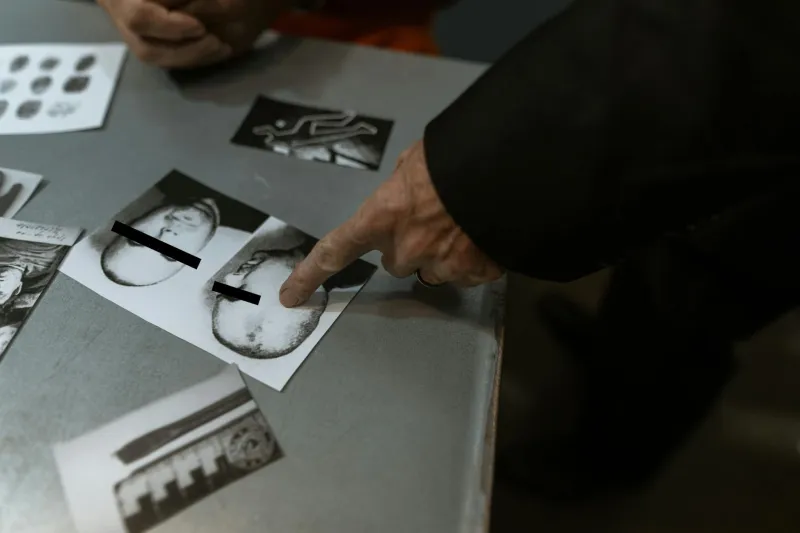
The Paper Era
Let's say you were arrested in 1985. Here's what happened: A police officer brought you to a precinct, where a desk sergeant booked you into a ledger—an actual physical book. Your name, the alleged crime, the time of arrest. Another officer took your photograph with a camera loaded with film. You stood in front of a wall with numbers, your expression captured in black and white, and that photograph would eventually be developed and printed.
Then came the fingerprints. An officer rolled each of your fingers across an ink pad, then pressed them onto a card, one finger at a time. The process took time and required a certain amount of skill—too much pressure and the print smudged; too little and it didn't show clearly. The card was labeled with your name and case number, then filed in a cabinet at the police station and sent to the state police, where it was filed in another cabinet.
If you were wanted in another state, or if you'd been arrested before, someone had to physically locate your previous records—assuming they could find them at all. A wanted poster might be sent around. Departments coordinated through phone calls and mailed documents. A criminal history was fragmented, incomplete, and often took weeks to assemble.
Your mugshot and fingerprints were yours—held by police, filed away, but not broadcast. If you were acquitted or charges were dropped, your record might theoretically disappear, though in practice, paper trails were harder to erase than digital ones.
The system was slow, inefficient, and prone to human error. But it had a strange property: information about you was localized. The police in one state didn't automatically know what you'd done in another. Your digital footprint didn't exist.
The Digital Revolution
By the early 1990s, computerization was beginning. By the 2000s, it was complete. Every mugshot became a digital image instantly searchable and shareable. Fingerprints were scanned and compared against national databases using algorithms. Arrest records synced across departments in real time. A police officer in Arizona could pull up your entire criminal history—arrests, convictions, warrants—in seconds.
The infrastructure became staggering in scope. The FBI's Next Generation Identification (NGI) system, fully operational by 2014, contains fingerprints of over 100 million people. It can match a partial fingerprint from a crime scene to a person in the database in minutes. Facial recognition software, still controversial and imperfect, can identify suspects from security footage. License plate readers scan thousands of cars per day, creating a real-time map of movement. DNA databases connect crimes across years and jurisdictions.
When you're arrested today, the digital machinery springs to life instantly. Your mugshot is uploaded to systems accessible by thousands of law enforcement agencies. Your fingerprints are scanned and checked against national databases. If you have any prior arrests, they appear immediately. Body cameras record the arrest, creating a video record that didn't exist before. Your phone, if seized, contains a complete digital history of your movements, communications, and associations.
Within hours, information about you that once took weeks to assemble is available to anyone with access to the system.
The Accountability Paradox
There's an intuitive argument here: more information, more visibility, more technology should mean more justice. And in some ways, it has.
Technology has made it harder to get away with certain crimes. A murder in 1985 might go unsolved because the perpetrator left no obvious evidence. The same murder in 2024 might be solved by DNA, facial recognition, or digital evidence. Cold cases that seemed permanently unsolved have been cracked decades later using technology that didn't exist when the crime occurred. Innocent people have been exonerated through DNA evidence, a form of proof that didn't exist before.
Body cameras, introduced widely in the 2010s, created a new form of accountability. Police brutality, once often he-said-she-said, became documented on video. Some studies suggest that body cameras reduce use of force and citizen complaints, though the effect is smaller than advocates hoped. At minimum, they create a record.
But visibility cuts both ways.
Digital records have become harder to escape. In the paper era, if you were arrested but charges were dropped, your record might languish in a filing cabinet, slowly forgotten. Today, your mugshot lives online forever. A simple Google search pulls up arrest records that are technically public but would have been effectively invisible in 1985. Employers, landlords, and potential partners can find it instantly. A misdemeanor from twenty years ago follows you permanently.
This has profound consequences for reintegration. Formerly incarcerated people are trying to rebuild their lives in a world where their arrest record is one search away. The promise of a second chance is harder to fulfill when your past is permanently archived and instantly accessible.
The Bias Problem
Here's where technology reveals something uncomfortable: it doesn't fix bias; it scales it.
If a police department has a history of over-policing certain neighborhoods, that bias gets embedded in the data. An algorithm trained on historical arrest data learns to predict that certain areas are more likely to have crime—because they've been policed more heavily, not because they have more crime. The technology then recommends deploying more officers to those areas, creating a feedback loop.
Facial recognition software has been shown to have higher error rates for people of color, particularly Black women. When this technology is used to identify suspects, it can lead police to arrest the wrong person. Several high-profile cases of wrongful arrests based on faulty facial recognition have emerged in the last few years.
Drug enforcement, powered by data analysis and digital surveillance, has disproportionately targeted Black and Latino communities, even though drug use rates are similar across racial groups. The visibility that technology provides doesn't create fairness—it documents and systematizes existing inequities.
What Actually Changed
The machinery of arrest and booking is almost unrecognizable compared to forty years ago. What once took hours now takes minutes. What was once fragmented across filing cabinets is now centralized in searchable databases. What was invisible to the general public is now permanently documented and archived.
But the fundamental question—whether the system is fairer—is more complicated. Technology has made some aspects of justice faster and more certain. DNA evidence has exonerated innocent people. Body cameras have created accountability. But technology has also made it harder to escape your past, easier to embed existing biases, and more efficient at surveilling and controlling certain populations.
The 1985 system was slow and inefficient, but it had built-in forgetting. A person arrested for something minor in a small town could move to another state and start over. Their record would follow them eventually, but not immediately. There was time and friction.
The 2024 system is fast and interconnected, but it has permanent memory. Every arrest, every booking, every mugshot lives forever in searchable databases. The system doesn't forget, which means it doesn't forgive.
Technology didn't solve the problem of criminal justice. It just changed the shape of the problem. We're faster at catching people, but not necessarily better at distinguishing guilt from innocence, or at helping people rebuild their lives after arrest. We've made the system more visible, but not necessarily more fair. We've traded the inefficiency of paper records for the permanence of digital ones, and we're still figuring out whether that was a good trade.