Before FEMA and Insurance Adjusters, Your Neighbors Were Your Safety Net
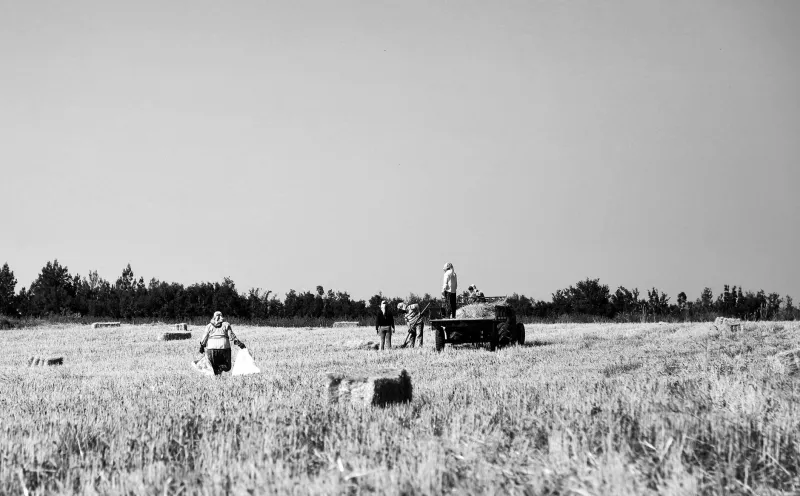
Somewhere around 1934, a wheat farmer in rural Kansas broke his leg falling from a grain elevator. He didn't file a claim. He didn't call a hotline. He didn't even own a phone. What he did was send his oldest boy down the road to the Hendersons, who told the Murphys, who told everyone at Sunday service. By Monday morning, six neighbors were in his fields before sunrise.
No invoice. No paperwork. No deductible.
That's not a heartwarming folk tale. That was the system.
What Workers' Comp Replaced — And What It Didn't
Formal workers' compensation laws didn't arrive in most American states until the 1910s and 1920s, and even then, agricultural workers were largely excluded for decades. Disability insurance as a widespread product didn't reach ordinary working families until well into the mid-twentieth century. Employer-sponsored sick leave was a perk, not a standard.
So what happened when a farmer, a blacksmith, or a mill hand got hurt and couldn't work for two months?
The community showed up.
This wasn't charity in the modern sense — a check mailed from a distant agency. It was physical, immediate, and deeply personal. Neighbors rotated through your fields. Church women organized meal schedules. The local feed store extended credit with a handshake. Barn raisings are the famous version of this, but the same logic applied to injury, illness, illness in the family, drought, and flood. The informal safety net was woven into the daily fabric of rural American life because it had to be. There was nothing else.
The Economics of Mutual Obligation
What made the system work wasn't altruism alone — it was reciprocity. Everyone understood, without it ever needing to be stated, that the help you gave today was the help you'd receive someday. Farmers who showed up for a neighbor's harvest in August knew that neighbor would show up for theirs in September. The ledger was never written down, but it was always kept.
Sociologists call this "social capital" — the accumulated trust and obligation between members of a community. In mid-century rural America, that capital was extraordinarily high. People lived near the same families for generations. They worshipped together, traded together, and buried each other's dead. When misfortune arrived, the response was automatic, not because people were inherently more generous, but because the social infrastructure demanded it.
The injured farmer wasn't a stranger navigating a bureaucratic system. He was Jim, whose father helped your father clear the south field thirty years ago.
When the Formal System Arrived
The expansion of formal insurance and government assistance programs through the mid-twentieth century — Social Security disability benefits, expanded workers' comp coverage, employer health insurance tied to postwar labor agreements — was genuinely transformative. People who had previously faced destitution after a serious injury now had a financial floor beneath them. That was real, meaningful progress.
But the transition came with a trade-off that nobody quite announced.
As formal systems took over the function of the informal network, the informal network quietly stopped being maintained. Why coordinate a neighborhood work rotation when an insurance check covered the gap? Why organize a meal train when the hospital had a social worker? The systems that replaced community support were more reliable, more scalable, and far less dependent on whether your neighbors happened to like you.
They were also far more transactional — and far more isolating.
The Loneliness That Followed the Policy
There's a reason social isolation has become one of the defining public health concerns of the 21st century. The U.S. Surgeon General declared loneliness an epidemic in 2023. Researchers have linked chronic isolation to outcomes as serious as heart disease and early death. And while the causes are complex, one thread running through the data is the gradual erosion of the kinds of tight-knit, mutually dependent communities that once made informal safety nets possible.
When you don't need your neighbors to survive a bad season, you stop building the kind of relationships that would make asking for help feel natural. The insurance policy is more dependable than the Hendersons — but it doesn't sit with you on the porch afterward.
This isn't an argument against insurance. It's an argument for noticing what changed.
What Some Communities Still Carry Forward
It's worth noting that these older patterns didn't disappear everywhere. Amish communities in Pennsylvania and Ohio still practice a version of the original model — communal barn raisings, shared labor during illness, support that is physical and present rather than financial and remote. Tight-knit immigrant communities in American cities have often maintained similar webs of mutual obligation, particularly in the absence of formal safety nets for undocumented workers.
These aren't throwbacks. They're proof that the model still functions when the social infrastructure supporting it is intact.
The rest of us traded that infrastructure for convenience and reliability — and mostly got a good deal. But the next time a neighbor goes through something hard and you wonder whether to knock on the door or just send a Venmo, it's worth remembering: your great-grandfather didn't have to wonder. He just showed up.
And so did everybody else.