You Used to Leave the Hospital in a Wheelchair. Now You Leave in a Rideshare.
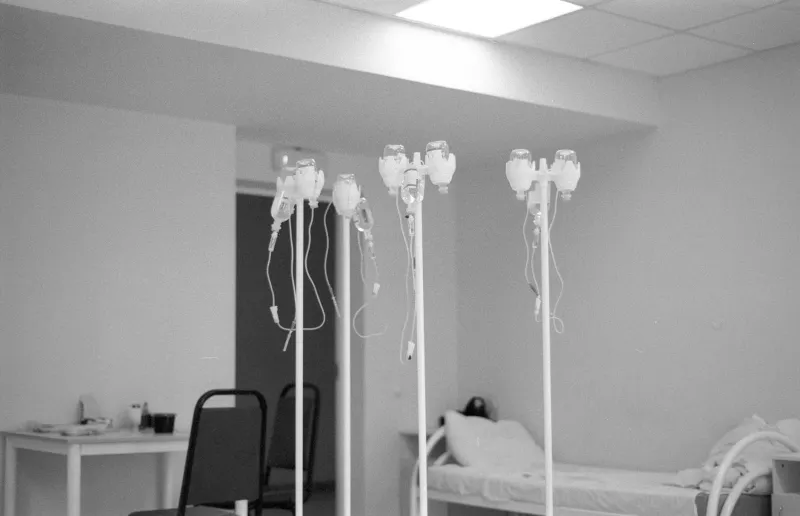
Somewhere in a box of old family photos, there's probably a picture of a relative lying in a hospital bed surrounded by flowers, get-well cards taped to the wall, and a look of resigned patience on their face. They weren't critically ill. They'd just had their appendix out, or a hernia repaired, or a gallbladder removed. And they were going to be right there, in that bed, for the next ten to fourteen days.
That was just how it worked.
Today, a gallbladder removal sends most patients home the same afternoon. An appendectomy? You might be back on your couch by evening. The American hospital stay has undergone one of the most dramatic compressions in modern medicine — and most of us have barely noticed.
When the Ward Was the Recovery Room
For much of the twentieth century, the hospital wasn't just where you went to get fixed. It was where you went to heal. Doctors and nurses operated on the belief that the body needed supervised rest, and that meant keeping patients in-house for extended periods that would seem almost unimaginable today.
In the 1950s and 1960s, the average hospital stay in America ran somewhere between seven and fourteen days, depending on the procedure. A normal vaginal birth kept a mother in the maternity ward for five to seven days. A tonsillectomy might mean a week's stay for a child. Even relatively minor procedures came with what was essentially a mandatory convalescence period, monitored by staff, structured around meals, medication rounds, and daily check-ins from a physician who actually had time to sit down and talk.
The ward had a rhythm to it. There was something almost communal about long-stay hospital culture — patients in neighboring beds who became unlikely companions, nurses who learned your preferences and your anxieties, a pace of recovery that felt deliberate rather than rushed.
Nobody loved being in the hospital, of course. But there was a certain logic to the idea that healing was a process that deserved time and attention.
What Actually Changed — and Why
The shift didn't happen overnight, and it wasn't driven by any single breakthrough. It was a convergence.
Anesthesia improved dramatically through the latter half of the twentieth century. Older anesthetic agents left patients groggy, nauseous, and disoriented for days. Modern formulations wear off faster, with fewer side effects, allowing patients to be alert and mobile within hours of a procedure.
Surgical techniques transformed just as significantly. The open surgeries of earlier decades — large incisions, significant tissue disruption, long healing times — gave way to laparoscopic and minimally invasive approaches. A procedure that once required a surgeon to open up a patient's abdomen can now be performed through a few small punctures, dramatically reducing trauma to the body and the time needed to recover from it.
And then there was insurance.
It would be incomplete to tell this story without acknowledging the financial pressure that accelerated the discharge timeline. Beginning in the 1980s, Medicare shifted to a fixed-payment model that reimbursed hospitals based on diagnosis rather than length of stay. Suddenly, a longer stay wasn't just unnecessary — it was a financial liability. Private insurers followed suit. The incentive structure of American healthcare quietly but decisively rewrote the recovery playbook.
The result: the average American hospital stay today is roughly 4.5 days, according to federal health data. For many procedures, it's measured in hours.
The Genuine Wins
Let's be clear about what's actually better. A lot of it is genuinely better.
Faster recovery times mean less exposure to hospital-acquired infections, which remain a serious and underappreciated risk. Patients sleeping in their own beds, eating food they recognize, surrounded by people they love — that has real therapeutic value that hospital administrators of the 1950s probably underestimated.
Minimally invasive surgery isn't just faster. It's less traumatic, involves less blood loss, produces smaller scars, and carries lower complication rates for many procedures. The compression of hospital stays is, in large part, a story of genuine medical progress.
For patients with strong home support systems — a partner who can drive them to follow-up appointments, family members who can help them manage medications, comfortable living situations — early discharge often works well. Recovery happens, just in a different setting.
What Got Quietly Left Behind
But there's another side to this, and it doesn't get talked about enough.
The rapid-discharge model assumes a lot about the patient's life outside the hospital. It assumes someone will be home with them. It assumes they can follow complex post-operative instructions while still groggy from anesthesia. It assumes they have reliable transportation to follow-up appointments, and that they'll recognize warning signs that warrant a return visit.
For many Americans — particularly elderly patients, those living alone, or those without strong social networks — being sent home before they're truly stable isn't a convenience. It's a risk.
Hospital readmission rates tell part of that story. Roughly one in five Medicare patients is readmitted within thirty days of discharge. That's not a small number. Some of those readmissions are unavoidable. But some represent patients who were simply discharged before they were ready, without adequate support for what came next.
There's also something harder to quantify that was lost when the long ward stay disappeared. The extended hospital stay, for all its inconveniences, created a period of enforced pause. You couldn't go back to work. You couldn't pretend you were fine. You had no choice but to rest, be cared for, and let the healing happen at whatever pace it needed.
Now we hand patients a discharge summary, point them toward the exit, and trust that they'll figure out the rest.
The Recliner at the End of the Hall
Many outpatient surgical centers now have what they call recovery recliners — comfortable chairs in a supervised area where patients spend a few hours before being cleared to leave. It's efficient. It's modern. It's often perfectly adequate.
But if your grandfather could see it, he'd probably have questions.
The story of the shrinking hospital stay is genuinely one of progress. The medicine is better. The surgeries are less brutal. The infections you don't catch by going home early are real infections you don't catch.
Still, somewhere between the two-week ward stay and the same-day recliner, something got compressed that wasn't just inefficiency. It was the acknowledgment that getting better takes time — and that sometimes, people need more than a printout of discharge instructions to actually do it.