She Knew You Loved Mysteries Before You Did. The Algorithm Just Knows You Clicked.

If you grew up in America before the internet, there's a decent chance you can picture her. She had a particular way of tilting her head when you described what you were looking for — not quite satisfied with your answer, thinking past it to something better. She knew the shelves the way a musician knows a fretboard. And she had a habit of handing you a book you hadn't asked for and saying, with complete confidence, you'll like this one.
She was usually right.
The school librarian was one of the more underappreciated figures in American education — a specialist in matching curious young minds with the specific books that could ignite them. Not just any book. The right book. For you. Right now.
That role is disappearing. And what's replacing it isn't quite the same thing.
The Library as the Center of the School Universe
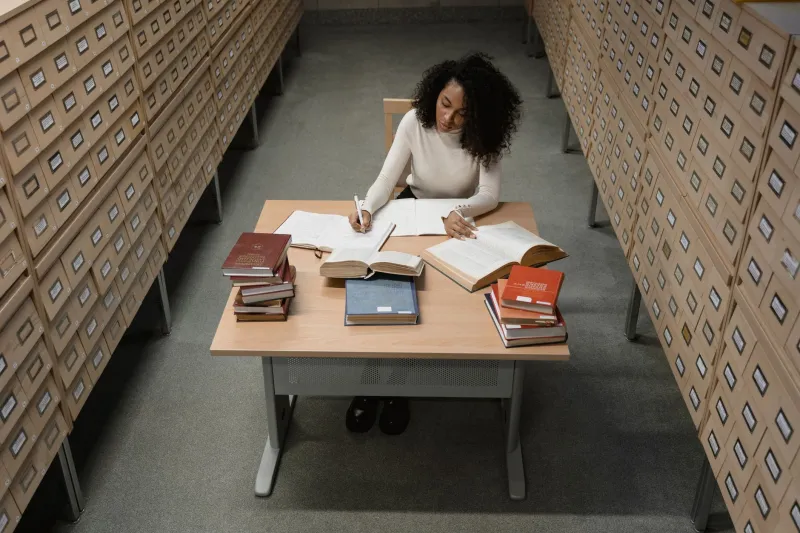
For much of the twentieth century, the school library was a genuine institution. It wasn't just a room full of books — it was the intellectual hub of the building, the place where assigned research happened but also where unassigned curiosity was welcome. The librarian was a credentialed professional, trained not just in cataloging and collection management but in child development, reading pedagogy, and what educators call reader's advisory — the art of connecting a specific person with a specific text.
In practice, this meant knowing kids. A good school librarian knew which students were reluctant readers and which were voracious ones. She knew who was going through something difficult at home and might need a book that offered escape or comfort. She knew the kid who'd exhausted every book in the mystery section and was ready to be challenged with something longer and more complex. She knew these things because she paid attention over months and years, and because children told her things in the quiet of the library that they didn't always say elsewhere.
This was human intelligence applied to the problem of intellectual development. It was slow, personal, and remarkably effective.
The Defunding of a Profession
American school libraries began losing ground in the 1990s, and the decline accelerated sharply after the 2008 financial crisis when school budgets were cut across the country. The librarian — perceived as a support role rather than a core teaching position — was often among the first to go.
The numbers are stark. A 2020 report from the American Library Association found that the number of school librarians in the United States had dropped by nearly 20 percent over the preceding decade. In some urban districts, the cuts were far more severe. Entire schools eliminated the position entirely, leaving libraries staffed by aides or parent volunteers, or simply locking the doors.
The rationale was usually financial, but there was a technological assumption underneath it: kids have the internet now. They don't need a person to help them find information. They can find anything themselves.
This reasoning sounds logical. It is also, in a meaningful way, wrong.
What the Algorithm Actually Does
When a child today searches for a book recommendation — or when a school deploys a digital reading platform to replace the librarian's function — what happens is something quite different from what the librarian did.
Algorithms recommend based on behavior. They look at what you've read, what you've clicked, how long you lingered on a page, what students with similar profiles have chosen. This is useful, in a narrow sense. If you liked one dystopian novel aimed at middle schoolers, the algorithm will surface three more. The feedback loop is fast and frictionless.
But the algorithm has no idea what you actually need. It doesn't know that you've been reading the same genre for two years and are ready to be stretched. It doesn't know that you're a reluctant reader who needs a book with short chapters and a gripping first page, not a five-star average rating. It doesn't know that the reason you keep clicking on sports books is because you're desperately looking for a story about belonging, not statistics.
The librarian knew these things. Or she found them out by asking.
There's also a more fundamental problem with giving children unmediated access to search engines as a replacement for guided discovery: the internet does not distinguish between what is worth reading and what merely exists. A child searching for information about a historical event will surface Wikipedia, credible journalism, fringe conspiracy sites, and academic papers written for adults — all with roughly equal prominence. The skill of evaluating sources, understanding credibility, and knowing what to trust is precisely what a trained librarian taught. It is not what a search engine provides.
The Reading Life Begins With a Recommendation
There's substantial research connecting early reader identity — the sense of yourself as someone who reads and enjoys reading — with having been matched with the right book at a formative moment. Not the assigned book. The chosen book. The one that felt like it was written for you specifically.
For a lot of American adults who count themselves as readers, that moment came courtesy of a school librarian who took a chance on a recommendation. A Wrinkle in Time pressed into the hands of a kid who thought she hated science fiction. The Outsiders given to a boy who'd never finished a novel. Island of the Blue Dolphins offered to a girl who'd said she only liked animals.
Algorithms don't take chances. They optimize for what they already know about you. That's a fundamentally different thing from what a thoughtful adult does when she hands you something unexpected and says: trust me.
What a Generation Is Growing Up Without
Children today have access to more books than any generation in history. E-readers, digital library platforms, audiobooks, and online archives have made the sheer volume of available reading material almost incomprehensible.
And yet reading rates among American children and teenagers have declined. The percentage of young people who describe themselves as daily readers has dropped steadily over the past two decades. Access, it turns out, is not the same as engagement.
A library with no librarian is, in a real sense, just a room. The books are there. The discovery is not.
There's something worth sitting with in that. We built systems that can surface a million book options in an instant, and we defunded the person who knew which one of those million books you actually needed. We optimized for efficiency and lost the irreplaceable thing — the human being who saw you clearly enough to know what you were ready for before you knew it yourself.
The algorithm knows your click history. The librarian knew you.
That's not a small difference. For a lot of kids, it's the difference between becoming a reader and not.